What’s in my bag? The small venue survival kit list
Welcome back. If you have read through parts 1 and 2 of this survival guide you will have noticed what a challenge these gigs can be, and that as a small venue sound engineer, you are much more than just the sound tech. You are often also the maintenance person, backline tech, electrician, decorator, and general jack of all trades… As, like I have mentioned earlier, apart from you there will be nobody else in the venue to help with all this.
So, what equipment, aside from your trusted headphones and the mandatory torch, will help you get through the small venue gig with the minimum amount of pain? And what could even make you the hero of the day? Here is a run through all those special little titbits that I like to carry for small venue gigs, and often even big venue ones.
Electrical tape, gaffa tape, and sharpie have been mainstay accessories for sound engineers for ages. And even in this digital age they are still essential items, for labelling things (desks, cables etc), but also for fixing things, preventing stuff from slipping about, and tackling these all pervasive ills of the small venue, the mic stand that will not stay up because a screw is…screwed, or the mic clip that is too big for the mic you need to use. Mic clip thread adapters from small to big and the other way around will of course be one incredibly useful addition to your kit to tackle this other related ill: the mic clip threads that do not fit the ones on the mic stands.
Your most important best friends to master the small venue game however, as mentioned in part 1, are the humble cable tester and signal generator. Those two accessories – which can also come as one – will go miles for excluding all the broken cables waiting to ruin your gig and checking if your stage lines work – a process I have outlined in part 1. Personally, I am reluctant to use any cables or lines if I haven’t tested them first and I consider those two things as probably among the most useful pieces of kit.
The second most useful piece of equipment for the small venue are Cympads. I can say that these incredible, cheap accessories have saved more small venue gigs than I can think of. They are small rubber pads that go on your cymbals instead of the felts, to keep cymbal noise under control (a big issue in small venues). This allows you to actually mix the whole band quieter and concentrate on getting the vocals heard, as the vocal mics will often end up being straight in front of the cymbals….which means that if you try to turn the vocals up you just end with even more cymbals. Often the band turns up with loud drums, guitars, and everything, that fill the whole sound in the venue on their own, and then add untrained vocalists who would have had no chance to be heard save it for the Cympads.
Next, unless you are trained enough to faultlessly recognise frequencies, a spectrum analyser – you can get them as an app on your phone – will also massively help you find feedback in situations where your mixer has none.
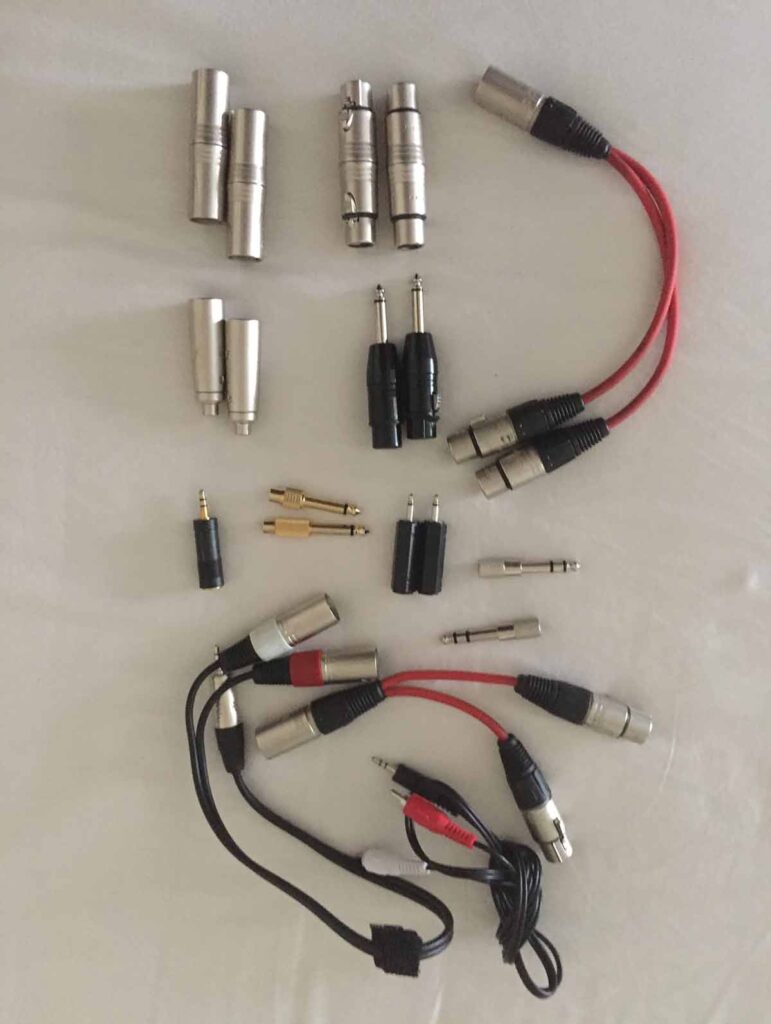
A bag full of adapters from XLR to everything and everything to XLR and in-between will also be helpful, as will be XLR gender benders, Speakon couplers, and a lot of those iPhone adapters as you will keep losing them at an alarming rate.
A set of screwdrivers and a multitool are also obvious must-haves. Unusual heads, like torx etc…and precision screwdrivers should feature in this set. You’ll be surprised at how many different types of screws make it into equipment and how often things need to be fiddled with ahead of a gig. Do not forget some scissors.
Another good investment is a router to hook up your iPad to your mixer, which can immensely improve your monitor ringing out process. And yes, an iPad.
While small venues usually have a basic set of 57s and 58s, they often have little else. Investing in a few specialised mics, like kick a drum mic or condensers, is therefore a good thing to think about. They do not have to be super expensive, can be second hand, but they will still be a massive improvement over the unknown battered entities that the venue may have sitting in a case, or none.
Also get yourself a bunch of passive DIs. Those will save the day when the venue’s DI boxes refuse to be found, or you’re left with no channels that want to pass phantom. The same as above applies. They can be second hand or cheap brands. You can always buy more expensive gear once you start climbing the sound engineer ladder.
A foam for mics can be very useful for buffering a kick mic against a kick drum without a hole, and even in the slightly iffy situation when the singing guitarist gets electric shocks when they touch the mic with their mouth – which can happen when some performers have creative DIY wiring on their effects pedals.
Do not forget your phone with an audio cable, as you’ll usually also be asked to play some music between bands. And, unless you want to treat your jazz audience to your favourite doom metal bangers, have a playlist with inoffensive random music. Many play Spotify although it seems it’s not technically legal in a public space. Also have a playlist with your reference “system tuning songs” in it that will allow you to get an idea if your PA actually plays your songs to make them sound like music or not and what you need to change so it kind of does.
Apart from these things listed above there are also further items that are nice to haves but that will occasionally turn you into the hero of the day. One of them is a drum key, as it is surprising how often the drummer will have forgotten theirs. With this in mind, it is also a very good idea to get acquainted with backline equipment, i.e., how to set drums up, and how guitar amps work, as yes again it is often up to you to deal with those as well. Another such item are fuses for mains and fuses that are slow blow for things like guitar amps. Have a set of these with various gradings with you. These will only very occasionally come in handy, but will be a life saver when they are needed. And for when things get really dire, a multimeter and a basic soldering iron can also save the day. Although hopefully not often needed these will one day literally save the gig from a potential show stopper issue.
Of course, nobody buys all of this equipment outright from the first day. But these things accumulate over time, and it is always a good idea to have a little wish list tucked away somewhere for when there is a bit of extra cash to spend. Every now and again you will come across a situation where you think that having this or that little thing would have helped. And that is when it goes on the shopping list for your ever-expanding bag of kit.
Ok folks, so, that’s it. Thank you for staying with me through these three episodes of the Small Venue Survival Guide. Hopefully these will be helpful and will make your start into world of sound less daunting and allow you to make your first steps without being thrown sideways by the unpredictable nature of small venue gigs.